The Sustainable Development Policy Institute (SDPI) is holding its Tenth Sustainable Development Conference (SDC) from 10—12 December 2007 in Islamabad, Pakistan. Each SDC is designed to be a forum for sharing and exchanging dialogues on sustainable development with practitioners, civil society and policy-makers. The SDC series has been established as a prime Conference in South Asia on development issues attracting leading intellectuals and policy-makers to come together. Some 71 panelists from 12 countries participated in the Ninth SDC in December 2006. An anthology based on peer reviewed SDC papers is published and launched at the succeeding Conference. The published books form part of curricula on development of some of the educational institutions within Pakistan and are also quoted in research publications.
The overarching theme of the SDPI’s Tenth SDC is Sustainable Solutions: A Spotlight on South Asian Research.
Many countries in South Asia have remained less developed for decades and Pakistan is no exception. The conditions of poverty, illiteracy, ill health / morbidity prevail, despite efforts to overcome them financially and practically. It appears, therefore, that the efforts to eradicate these conditions are not sufficiently successful. Often, these efforts are not in sync with on ground requirements to address the root causes, and may in fact worsen the situation by adopting unplanned approaches.
The SDPI has had the opportunity of organizing nine Sustainable Development Conferences on issues specific to (under) development and one impression that has emerged is that as we address specific questions through research, more questions appear – making any attempts at providing holistic, broad recommendations, limited in applicability. In many cases, social, environmental and economic issues are complicated and no single strategy can be regarded as conclusive. Another impression is that stakeholders including researchers/policy makers and academics have overlooked the importance of sustainable solutions that incorporate the aspirations, psychology and behavior of communities into problem identification and alternative solutions development. Unfortunately, the mere identification of a problem and emphasis on its gravity is simply not enough. What is needed to bring this process full circle is providing thoughtful insights and practical solutions to the problems that a diverse range of communities face and break the cycle of condescending top down prescriptions, which tend to be made by those who are oblivious to the realities faced by affected communities.
The Tenth Sustainable Development Conference intends to discuss and present, sustainable solutions to problems of poverty, illiteracy, mortality and morbidity, environmental degradation and disaster management, gender inequality, insecurity and peace. It will focus on looking at both innovative solutions, as well as indigenously developed alternatives that have survived generations of development. Solutions that have been implemented in the 1 North and South, specifically those in the South Asian region where significant progress has been made in some areas, despite the overall unsupportive environment, will be discussed.
Solutions put forward in the Tenth Sustainable Development Conference will be shared with community based organization leaders, not for profit advocacy leaders, government policy makers and international non-governmental organizations’ (INGO) facilitators for future implementation. It is expected that this kind of evidence-based research will lead to collective learning and provide practical answers for development problems that are shared throughout the region.
There will be one main plenary each day in which prominent keynote speakers will be invited to address significant areas of sustainable development such as globalization and poverty; gender; health; and environment. The plenary each day will be followed by two to three concurrent sessions/panels on sub-themes covered under the overarching theme. The plenary will last for one hour and 30 minutes while the duration of each panel will be two hours and 30 minutes with three to five presentations by speakers.
The following sub-themes will be covered under the overarching theme:
I. Globalization
II. Gender
III. Environment and Disaster Management
IV. Health
V. History
Abstracts followed by papers are invited for the sub-themes under the overarching theme. Contact information of the panel organizers is provided to facilitate communication between a potential speaker and the respective panel organizer. A screening committee will review the abstracts. Speakers whose abstracts are approved will be required to submit their papers. Details and deadlines are given in the Author’s guidelines. The panels listed in the concept note are subject to change and modification depending on the response from potential speakers and their abstracts.
Book Launch
SDPI’s Missing Links in Sustainable Development (SD): South Asian Perspectives will be launched on 10 Dec. 2007 at the opening of the Tenth SDC 2007.
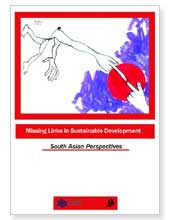 This anthology aims at identifying the missing links in Sustainable
Development for South Asia and proposes fillers for these. Questions
addressed in this anthology include why benefits of globalization have
failed to trickle down to the region's vast population and calls for a
process of global economic integration that benefits the marginalized. This anthology aims at identifying the missing links in Sustainable
Development for South Asia and proposes fillers for these. Questions
addressed in this anthology include why benefits of globalization have
failed to trickle down to the region's vast population and calls for a
process of global economic integration that benefits the marginalized.
Based on seventeen chapters and three sub-themes: Gender and Human Security,
the Economics of Globalization, and People's Rights and Livelihoods, the
research papers look at channels that exclude women from access to
resources, such as land, decent work, and human security, and suggest how
these structures can be changed. Many sound ideas about tackling
deforestation, compliance, sustainability and livelihoods problems in the
fisheries sector have been proposed. This anthology digs below the surface
of issues such as the connections between conflict in the public sphere and
its intensification in the private sphere, of how globalization can benefit
gender equality and women's empowerment in South Asia, and the role of trade
and aid in peace and progress, and suggests steps towards change.
|


